


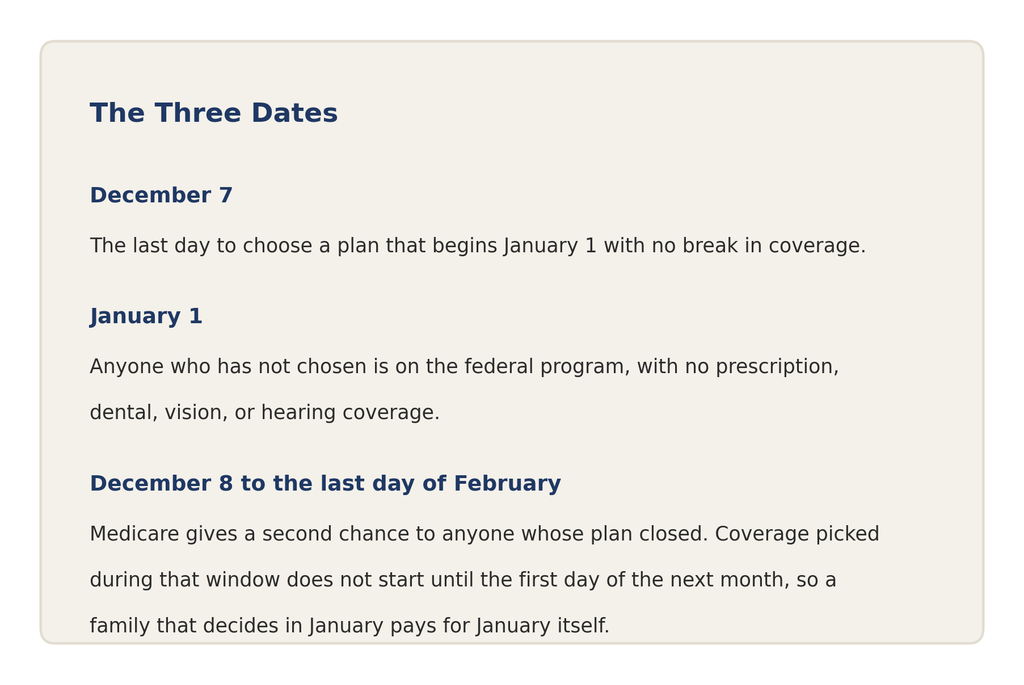
Most older adults who carry a Medicare Advantage plan chose it years ago and have not thought about it since, which is exactly what the plan is designed for. It arrives as a single package: hospital and doctor coverage from Medicare itself, plus prescriptions, dental, vision, and hearing bundled on top by a private insurance company. That convenience is the point, and it is also what makes a closure so disruptive. Humana and UnitedHealthcare are both closing a number of their Medicare Advantage plans on December 31, and the families affected have until December 7 to put something else in place.
The reason the deadline matters comes down to what Medicare itself actually covers. The federal program pays for hospital stays and doctor visits and nothing further. Prescription drugs, dental care, vision, and hearing have never been part of it. An older adult who takes no action is enrolled in that federal program on January 1, which means the coverage does not vanish so much as shrink back to what it always was underneath.
In January the pharmacy charges full price for the same medications the plan covered in December.
Both companies mailed non-renewal notices in early October, and the letter states the date the plan ends. Anyone who cannot locate it can call the customer service number on the back of the insurance card and ask directly whether the plan continues into 2027.
A family has two options. The first is to buy another Medicare Advantage plan. Healthfirst, EmblemHealth, MetroPlus, VNS Health, Elderplan, and Aetna all sell them in New York City, and Humana and UnitedHealthcare each still offer plans that are not closing. The second is to stay on the federal program and buy the rest separately. That means a Part D plan for prescriptions. It also usually means a Medicare supplement policy, which New Yorkers call Medigap. Medigap pays the hospital and doctor costs that Medicare covers only in part.
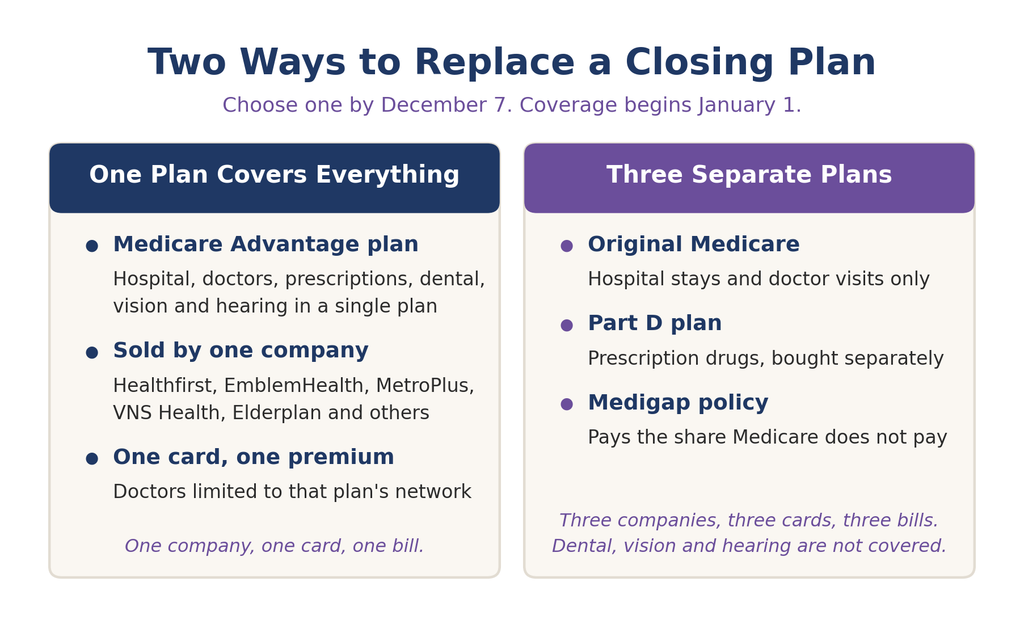
A Medicare Advantage plan is usually the cheaper of the two. Many charge no monthly premium at all, while Original Medicare requires buying a Part D plan and a Medigap policy, each with its own premium.
The doctors are where the two differ most. A Medicare Advantage company pays only the doctors under contract with it, so a family has to confirm that the primary care physician and every specialist accept the plan before enrolling. Original Medicare carries no such restriction, and almost every doctor and hospital in the country accepts it. Dental, vision, and hearing are carried by Medicare Advantage plans, but Original Medicare does not cover them at all.
Medigap policies come in lettered versions, and Plan G is the one most people buy. New York State sets what each lettered policy must cover, so Plan G pays the same costs no matter which company sells it. Only the price changes. The New York State Department of Financial Services publishes what every licensed company charges and lets anyone look up current prices by ZIP code.
Do not pick a Medicare Advantage plan by its monthly premium. A plan that charges no premium can cost more over a year than a plan charging forty dollars a month. The real cost depends on which drugs the older adult takes and what each plan charges for them. Medicare’s Plan Finder works this out. Enter every prescription with its dose and name the pharmacy the family uses, and the tool shows what each plan will cost for the full year. Choose the pharmacy carefully, because many plans charge less at certain pharmacies and more at all the others.
The Plan Finder will not tell you whether a plan covers the older adult’s doctors. Call each plan you are considering and ask by name about the primary care physician and every specialist. Make these calls before enrolling. Once the year starts, a plan that leaves out the neurologist cannot be changed until the following December.
HIICAP counselors explain Medicare Advantage, Medigap, and Part D to New Yorkers at no charge. They do not sell insurance. NYC Aging publishes their 2026 Medicare guide in several languages and lists counseling sites in all five boroughs.
Call Aging Connect at 212-244-6469 to reach a counselor. Medicare answers questions at 1-800-633-4227, 24 hours a day, seven days a week.

Sources: Centers for Medicare & Medicaid Services, Medicare Plan Finder and special enrollment period guidance; New York State Department of Financial Services, Medicare supplement insurance premium rates; New York City Department for the Aging, Health Insurance Information, Counseling and Assistance Program.