

Most older adults take more than one prescription, and many also take pills bought off a drugstore shelf. Some of those medicines carry risks after 65 that they did not carry at 50, and families usually learn which ones only after something goes wrong.
The reason lies in the liver and the kidneys. Both organs break medications down and clear them out of the body, and both slow with age, so a drug can build to a higher level or linger longer than it should. Older adults also grow more sensitive to certain medicines, which means a small dose produces a large effect. An adult treating several conditions at once may take five or six drugs that act on each other.
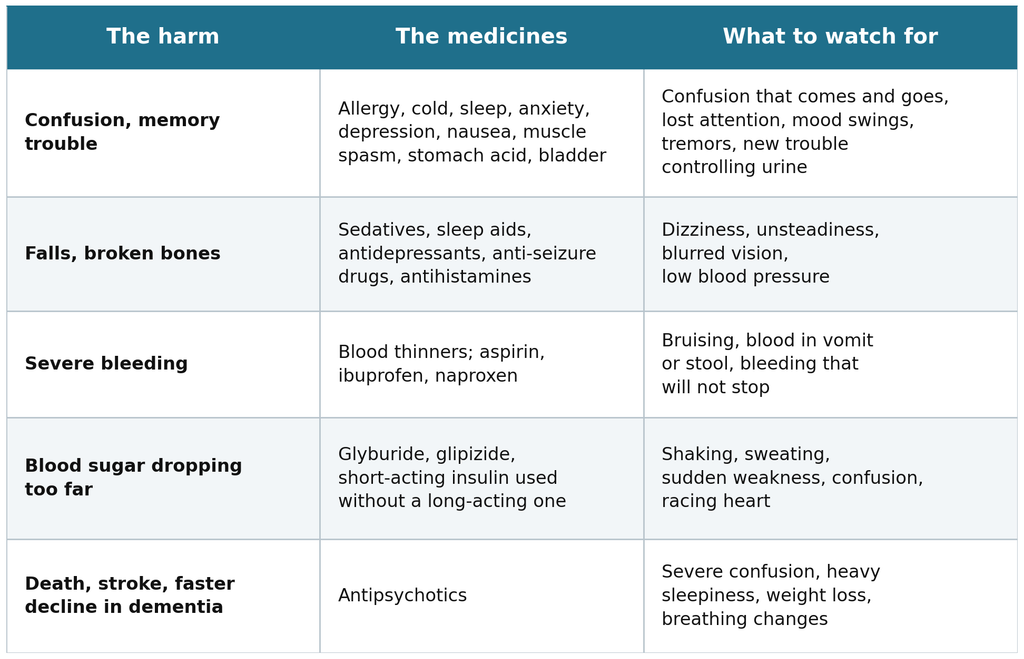
The American Geriatrics Society keeps a list of the medications whose risks outweigh their benefits for people over 65. Clinicians call it the AGS Beers Criteria, and it covers prescription and over-the-counter drugs together. The table below groups those medicines by the harm they cause.
⛔ Same-day emergency. A severe headache, sudden confusion, fainting, vomiting blood, or black or bright red stool means bleeding that will not stop on its own. Call 911.
The last row deserves more than a line in a table. Antipsychotic medications treat schizophrenia and bipolar disorder, and they also get prescribed to calm agitation in people living with dementia. The Food and Drug Administration issued its strongest warning against that second use in 2005, because these drugs affect the heart, the lungs, and breathing. A caregiver whose parent has been prescribed one should ask the prescriber what symptom it is treating and what was tried before it.
Families buy sleep aids and cold medicine off the shelf without thinking of them as risky drugs. Diphenhydramine is the active ingredient in Benadryl, and it is also what makes ZZZquil, Advil PM, and Tylenol PM cause drowsiness. Many cold and flu remedies contain it, and the front of the box does not say so. In an older adult, diphenhydramine causes confusion. Someone taking two products that both contain it gets a double dose without knowing it.
A caregiver can bring all of this to either a doctor or a pharmacist. The pharmacist often spots interactions first, because the pharmacy fills every prescription and the doctor’s office does not.
Before going, gather every bottle the older adult takes, including vitamins, supplements, eye drops, creams, and anything bought without a prescription, and put them in a bag.
Then ask three questions about each medicine. What condition does this treat. Is it still the right choice at this age. Can anything here be stopped. Write down the answers.
Do not stop any medication without the doctor’s instruction, because stopping certain drugs abruptly causes harm of its own.
Sources: American Geriatrics Society, AGS Beers Criteria for Potentially Inappropriate Medication Use in Older Adults; National Council on Aging, medication safety guidance prepared with the University at Buffalo School of Pharmacy.
The information in this article is for informational purposes only and is not a substitute for professional medical advice, diagnosis, or treatment. Always consult your doctor or a qualified health provider with any questions about a medical condition.