

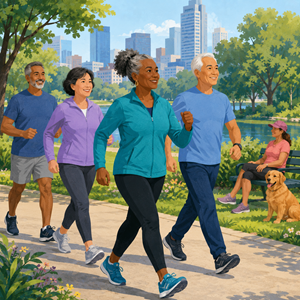
A new Harvard-reviewed study offers encouraging news for healthy aging.
Most of us know that walking is good for our hearts, muscles, and overall health. Now, new research suggests that how fast you naturally walk may also be linked to how well your brain ages.
A study highlighted by researchers at Albert Einstein College of Medicine, Columbia, and Stony Brook found that older adults who maintained a brisk walking pace well into their 80s were significantly less likely to experience memory loss or develop dementia than those who walked more slowly.
Researchers analyzed data from nearly 4,000 adults with an average age of 84. They identified a group they called “super-movers”—people who walked faster than about 93% of others their age during timed walking tests:
- Super-movers were about 50% less likely to develop cognitive impairment over the following several years.
- They were about 60% less likely to be diagnosed with Alzheimer’s disease or another form of dementia.
- Their memory, thinking speed, and ability to solve problems declined more slowly than their peers.
A Brain Health Difference
Brain scans revealed that these faster walkers tended to have a larger hippocampus, an area of the brain that plays a vital role in learning and memory. Interestingly, when researchers examined brain tissue after death, they found that super-movers had similar levels of Alzheimer’s-related brain changes as slower walkers. This suggests that while they weren’t necessarily protected from the disease itself, their brains may have been more resilient, allowing them to continue thinking and functioning well despite those changes.
Does Walking Faster Prevent Dementia?
Not necessarily. The researchers emphasize that this study shows a connection, not proof that walking faster directly prevents cognitive decline. It may be that people with healthier brains naturally walk faster, or that better physical fitness and brain health develop together over time. Still, the findings add to a growing body of research showing that staying physically active is one of the best things we can do for healthy aging.
What You Can Do
You don’t have to become a marathon runner to benefit. If your healthcare provider says it’s safe, consider:
- Taking regular walks several days each week.
- Gradually increasing your pace until you’re walking briskly but comfortably.
- Including strength and balance exercises to help maintain mobility.
- Listening to your body and avoiding overexertion.
Even small improvements in physical activity can support your overall health and independence.
It Boils Down to Health Choices
While no single habit can guarantee a healthy brain, maintaining an active lifestyle appears to be one of the strongest tools we have. If you’re able to walk comfortably, picking up your pace—even a little—may be another simple step toward staying mentally sharp for years to come.
As always, if you have concerns about your balance, heart health, or mobility, talk with your healthcare provider before beginning a new exercise routine.